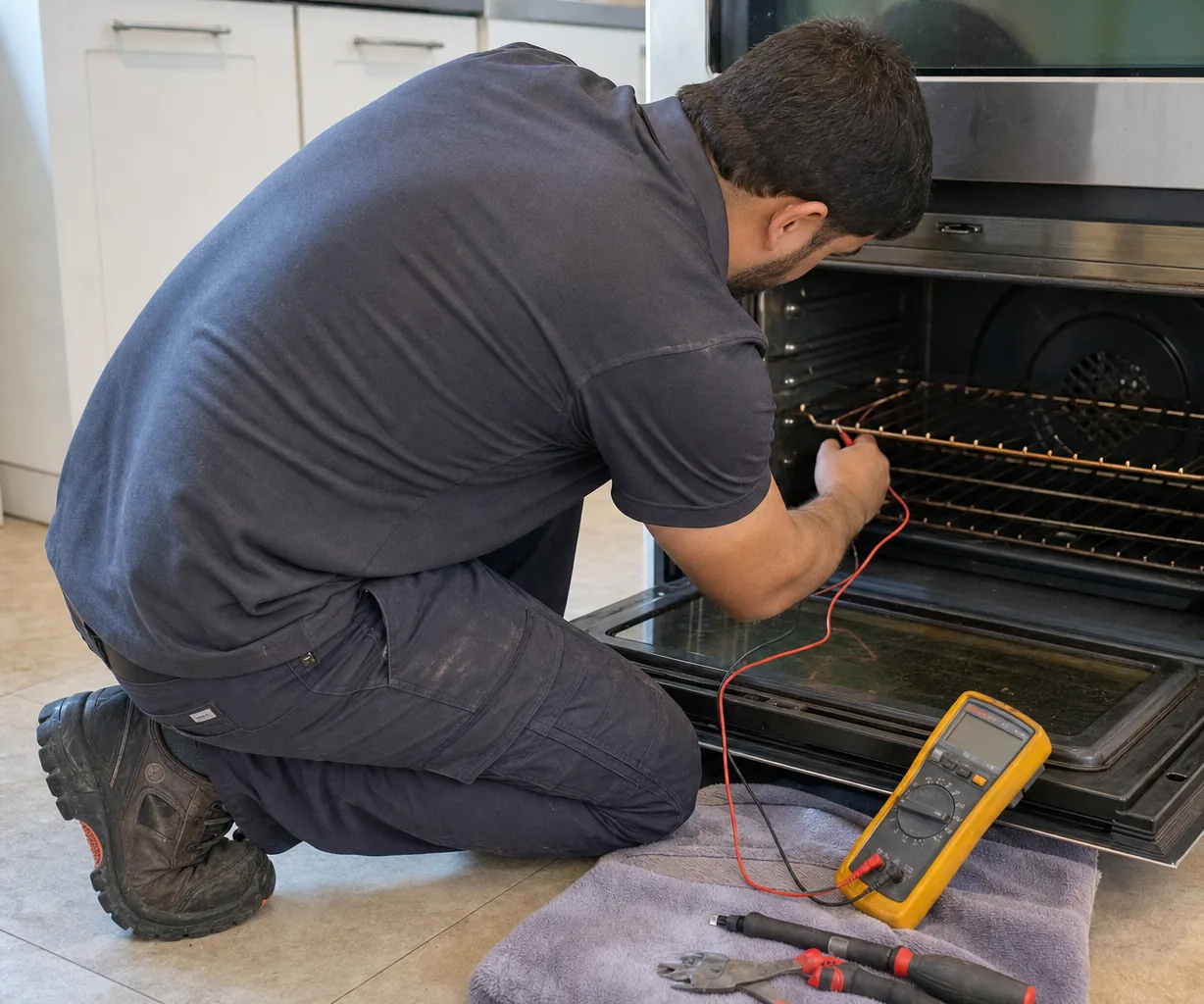
Two electrical facts account for a large share of the faults in Mandarin that look mysterious from the front of the appliance. The first is that most of these kitchens were wired before these appliances existed as a residential category. The second is that Jacksonville averages roughly sixty-eight thunderstorm days a year.
Every appliance here needs 120 volts, including the gas ones
This surprises people regularly. A gas range does not cook with electricity, but it needs a 120-volt supply for its spark module, its control board, its oven sensor circuit, its lights and its convection fan. A gas rangetop needs it for ignition. A hood needs it for the blower. So does the ice maker in a refrigerator that is otherwise entirely mechanical to look at.
A dual-fuel range and a wall oven need a 240-volt supply sized to the rating plate on the appliance, not to what happened to be in the wall.
What a shared circuit does
A kitchen built in the 1970s was wired for a refrigerator, a range and a couple of counter receptacles. Everything since — dishwasher, disposer, microwave, second refrigerator, wine storage, hood — was added to whatever was nearest.
An appliance sharing a circuit with anything that draws heavily does not fail. It misbehaves. The voltage sags briefly when the other load starts, and a control board that expects a stable supply sees something it did not expect. What you observe is an oven that occasionally forgets its cycle, an ice maker that skips a harvest, a hood that changes speed on its own, or a display that resets.
Those symptoms are indistinguishable from a failing board until you look at the supply. That is why we check the supply first on any intermittent fault, and why we will not sell a board to a circuit problem.
The neutral
A loose or corroded neutral connection is the single most destructive electrical fault we find in older houses, and it is quiet. On a 240-volt appliance a bad neutral lets the two legs float apart under unbalanced load, so one part of the appliance sees more than 120 volts and another sees less.
The result is components dying in ones and twos over months, with each replacement lasting a shorter time than the last. If a board has been changed before and failed again, the neutral is the first thing we look at.
Sixty-eight storm days
Jacksonville’s storm season is long and active. A strike does not have to hit the house to matter. A nearby strike induces a surge on the service, and utility switching during an outage puts transients on the line at both ends.
Control boards absorb these badly, and they usually do not die outright. The characteristic post-storm appliance still powers up but has lost exactly one function: a relay for the broil element that no longer closes, a display segment gone dark, a keypad that takes some presses and ignores others, an ice maker that fills but never harvests.
That single-function loss is the signature. A board that has been damaged by a transient behaves consistently — the same function fails every time — whereas a supply problem produces faults that move around.
What we check, in order
- Voltage at the appliance under load, not at rest.
- The neutral and ground connections at the appliance.
- Whether the appliance is on a circuit of its own, and what else is on it.
- The board.
The board is fourth for a reason. It is the most expensive item on that list and the most frequently replaced without cause.
Surge protection
If storms are a recurring problem at your address — and under the oak canopy in Old Mandarin they usually are — whole-house surge protection at the panel is the conversation worth having. It is installed by an electrician, not by us, and we have nothing to sell you in it. We mention it because we see the pattern often enough that not mentioning it would be dishonest.
Point-of-use protection at the receptacle helps a hardwired appliance not at all, since there is no receptacle in the path. That is worth knowing before you buy one.
The written estimate
If the finding is electrical rather than mechanical, the estimate says so in plain language and describes what an electrician would need to do. We would rather hand you that than fit a part into a problem a part cannot fix.